Orientation
Summary of Part I
In Part I of this article, I contrasted the differences between rising Multipolarism with a declining Anglo-American empire. Taking the side of the multipolarists of the East, I identified Lyndon LaRouche as someone who bridged the gap between East and West.
His concept of “The American system” defends the Enlightenment as the movement to look to if the west is going to join the multipolar world. I also presented Matthew Ehret’s book The Clash of the Two Americas: Volume I The Unfinished Sympathy as a concrete example of the battle between the British System and American system in the 18th and 19thcenturies. At the end of Part I, I raise questions as to where to place these advocates of the American system on the political spectrum and ask who its enemies are.
Are there times when centrism is unrealistic, ungrounded, and against common sense?
Unlike the left-wing and right-wing of the political spectrum, centrism is presented as a golden mean against the extremes. It embodied common sense, as opposed to fanaticism, pragmatism in contrast, unrealistic idealism and non-violence against violence. Yet there are times when centrism doesn’t work; occasions when centrism is not common sense, circumstances when centrism is not pragmatic, when compromise between extremes comes up empty. Not only is centrism unrealistic but the entire linear political spectrum founded at the end of the 18th century is bankrupt.
Strange bedfellows? Finance capitalists and the New Left
By the end of World War II, the financial capitalists had two enemies – the liberalism of FDR and the world communist movement. Most of us know the historical differences between the Old Left and the New Left. The Old Left represented the world communist movement as well as the forces of the Enlightenment. Is it possible that the emergence of the New Left with very different values driven by Romanticism was shaped by the anti-communist finance capitalists?
My claims in Part II
1)The political philosophy of the Anglo-American Empire and finance capitalists empire is centrism and it must be opposed.
2) The forces of Promethean City builders must dispense with the linear political spectrum create a new political spectrum which expresses its hopes.
3) For the past 70 years, the anti-communist forces of the Anglo-American empire have shaped a fake opposition, the romantic New Left, to oppose the development of a communist movement.
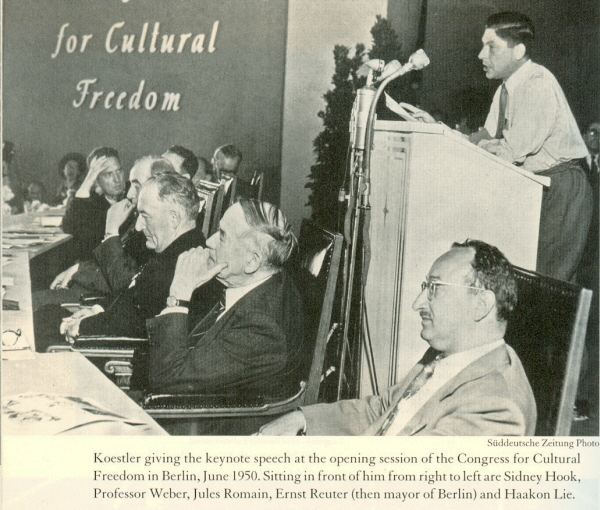
The first image at the top of this article includes arch anti-communists Arthur Koestler and Sidney Hook. The second image is the founder of Democratic Socialist of America, Michael Harrington, also an anti-communist.
Poverty of Centrism
As I wrote in my article: Are Socialists Going to Let Neoliberals Define Fascism?
All over the world, centrist parties are losing elections. People are either not voting at all or they are voting for fascists. In some countries people are voting for Social Democrats. The traditional choices between liberals and conservatives do not speak to world problems today. Additionally, just as centrist parties are collapsing (as depicted in the image above) so is the linear political spectrum model that serves as its visual description.
Today the fact that liberal and conservative parties are the same is far more significant than their differences. They have at least agreed on:
Support of finance and military capitalism as an economic system domestically
Never to discuss socioeconomic class in the way Marxists would
Suppressing third-party access into political debates.
Supporting imperialism around the world
Supporting the instillation of right-wing dictators
Supporting Israel elites despite 75 years of Zionist fundamentalism and their oppression of Palestinians
Opposition to state-centered socialism around the world
What this means is that:
There are far more commonalties between liberals and conservatives than there are between liberals and socialists because capitalism divides them
There are far more commonalities between liberals and fascists than between liberals and socialists because both liberals and fascists support capitalism
The linear political spectrum is too simple for today’s complex politics
Examples include:
China forming alliances with non-socialist countries like Russia and Saudi Arabia
Social Democrats (socialists) forming alliances with imperialists (Germany, Norway, Sweden). This goes way back to Social Democrats voting for war in 1914
Right-wing governments like Modi’s of India supporting a socialist country (China)
The Recent elections in France in which Le Pen (supposed fascist) has social programs to the left of Macron (a neoliberal)
A neoliberal Democratic Party supporting fascist Ukrainian forces
Centrism is bankrupt in extreme capitalist crises
The linear political spectrum also makes it appear that the middle of the political spectrum is compromising, pragmatic, down-to-earth and can never be unrealistic. Supposedly, centrists are moderate and not hysterical like the fascists or communists. What this ignores is that when there are extreme economic, political or ecological conditions the center doesn’t hold. It caves in. In certain periods of history being moderate is unrealistic. Gradualist trial and error won’t cut the mustard because a storm is so overpowering that it would overwhelm its centrist structures. Under the conditions of our time extremes are the only answer because of capitalism’s failure to address its contradictions. It has brought us to the point where neither liberal nor conservative solutions can nor will work. A new model of the political spectrum must be:
More inclusive of many more political ideologies
Economic as well as political
Able to account for qualitative leaps such as revolutions
Able to decenter the spectrum so that both moderate and extreme solutions would seem reasonable
Make room for alliances between the extremes on the political spectrum, not just among those next to each other
How the left and some conservatives might work together is because both are industrializers whose goal is to expand the productive forces. They may fight about how the wealth gets distributed but they agree that real wealth should be produced. By contrast, neo-liberals, fascists, Greens, Social Democrats, and anarchists are de-industrializers who abhor the introduction of new wealth-creation, especially nuclear technologies and city building. They are Malthusians.
We are now at the point where I can reintroduce the distinctions between the Enlightenment and Romanticism from Part I. I want to show how the Anglo-American empire, finance capitalists and the CIA shaped the New Left into embracing Romanticism.
Below is a table I developed from my book Forging Promethean Psychology which compares what the Enlightenment stands for as opposed to Romanticism.
Table A Enlightenment vs Romanticism Compared
Enlightenment (1715-1815)
Category of Comparison
Romanticism
(1750 – 1850)
Political – rights of man
Primary Identity
Cultural artistic identity
Against monarchist, aristocratic and religious
authorities. Respectful of scientific authority
Attitude Towards Authority
Critical of all authorities
Civilization brings out the best in humanity
Relationship Between
Civilization and Nature
Rebellion against civilization
Wants to “get back to nature”
Value what is modern and adult
Origins and development of culture and individuals
Value what is primitive in cultures; the innocence of childhood
Primitive superstitious stories before humans had science
Myths were also seen as lies told by priests
What is Myth?
Mythic stories hold the key to what is most important to being human
Grimm’s fairy tales
Trade was an improvement compared to control of land by kings, aristocrats and the Church
Attitudes Towards Capitalism
Against crass utilitarian commercialism of capitalism
Its predictability and lending itself to measurement
What is Valuable in Nature?
The wild, exotic and untamable
Deist – God is an engineer or watchmaker
Characteristics of Spiritual Presences
Pantheist – god is everywhere in nature. Birth of Neopaganism
Beauty – in symmetry with proportion
No unusual or accidental elements in art
Art Appreciation
Sublime – value what is unique, striking, or new; the unusual or accidental features in art.
In the eye of the spectator
What is the Arena for Judging Art?
In the creative process of the artist
Progress
Quantitative gradual change
How does Change Occur?
Revolutions
Qualitative change through crisis
Deliberation
Planning vs Spontaneity
Spontaneity
Reason should guide emotions
Place of Emotion and Reason
Emotions are valuable in and of themselves and should guide reason
Happiness, serenity, contentment
Types of Emotional States
Storm and stress
Mania and depression as signs of real living
Altered states, revelry
Confessing inner depths is bad taste
Self-revelations
Confessing inner depths is a virtue
Sincerity
Republican reformist
Politics
Revolutionary, apolitical
Conservative
Cosmopolitan
Exotic people became a laboratory for expanding theory of universal humanity
Cross-cultural Expansion
Parochial
Exaggeration of the differences between cultures
Holbach, La Mettrie
Diderot, Voltaire
Typical Theorists
Rousseau. Vico, Herder, Burke
The Politics of the Anglo-American Empire, The British System, Romanticism and the New left
The Old Left
As many of you know, soon after World War II capitalists in Mordor set out to destroy the Socialist and Communist parties. But the CIA also wanted to create a relatively harmless alternative to Communism by recruiting leftists who were critical of the Communist Party but did it in the name of socialist democracy. As many of you know, this began with the Congress of Cultural Freedom. Along the way, it helped to craft an ideology of the New Left that would render it harmless against capitalism while at the same time keep the Communist movement from growing back.
The heart of the Old Left was the defense of countries that were at least part way towards socialism – Russia, China and Cuba. Its economic focus was on the inherent contradictions of capitalism whether it be the tendency of the rate of profit to fall, underconsumption or the profit squeeze. Very importantly, communists were committed to the belief that Communism had to be based on abundance, which meant “developing the productive forces”. If a communist society’s economy stagnated that would introduce the temptation to steal. By producing more than enough stealing would not be an issue. As different as anarchists are from Marxists, even anarchists before the 1960s understood that abundance was the foundation for socialism.
The major social category for political organization was socio-economic class. It was only the working class that had the power to overthrow capitalism. Also, the only real democracy was economic democracy in which workers control what is produced, how much is produced and how it is distributed through centralized planning and workers’ control. In terms of political parties the Old Left advocated a Leninist vanguard party of dedicated revolutionaries.
While claiming that the workers were internationalists, in practice the Old Left political organization operated at the nation-state level. Whatever tiny ecology or changes in the climate movement existed it was not on the radar of communists. For communists’ growth of the human population was taken as given since by the second half of the 19th century and into the 1950s it seemed human productivity could easily accommodate a rising population.
When it came to the arts and psychology, the Old Left was fairly conservative. In the arts, socialist realist mural painting was predominant. In painting and music, the focus on working class life was its subject matter. In personal life, Communists usually did not drink and their appearance emulated working class clothes. Their personal life was relatively unimportant and their marriages were traditional. They were generally hostile to psychology, saw it as a bourgeois distraction from their main purpose was to work for the revolution. While most Communists were atheists, they understand that most workers were not, and they had to make relative peace with this “superstition” in order to organize workers. The CIA, and the Rockefellers set out to destroy the values of the Old left and replace with a very different orientation to the world. Table B displays the values of the New Left, and what is equally important, how these values support and are beneficial to the Anglo-American empire, finance capital, the Rockefellers, and the CIA.
Table B How the Values of the New Left Benefit the Anglo-American
Empire, Finance Capital the Rockefellers and the CIA
New Left (beginning in Early 1950s)
Category of Comparison
Benefit to Anglo-American Empire, Finance capital and the Rockefellers
Social Democrats, Anarchists
Complaints against excessive State control
Lack of worker participation
Point on Political Spectrum
All anti-communism for different reasons
Against all communist countries, planned economy
Rejection of Soviet Union, China, Cuba
In favor of Sweden, Norway, Denmark
Socialist Countries to Emulate
Loss of international identity
with large socialist countries
Even socialist countries need capitalism
No – capitalism can go on forever
Does Capitalism have Inherent Limits?
Throws push of politics onto voluntarism
Demoralizing people by imagining capitalism is much more flexible than it is and capitalists are more competent than they are
No – we already have too much
Socialism is based on morals or sustainability: Malthusianism
Does Socialism have to be Based on Abundance?
Teaching socialists to learn to do with less
Socialism based on “degrowth”
Race and sexuality: identity politics
Workers have proven to be too interested in material things to be revolutionary
Social Category for Socialist organizing
Race and sexuality don’t have the work location to organize
Diffusion of focus
Small is beautiful
Anarchist decentralization or planetary society
Rejection of nation-state
Political Scale
Rejection of the nation states which is the only political unit that can resist global capitalism
Makes an issue of lack of political party choices under socialism
Minimizes democratic gains under socialism in literacy, education and job security and health care
Place of Political Democracy
Diverts focus of socialists into focus on tiny political parties that are never strong enough to take power
Pay attention to Mother Earth
Go back to nature
Attitude to Ecology
The issue distracts from socialist organizing to overthrow capitalism Imagining ecological problems might be solved under capitalism
Earth has limited carrying capacity
Earth is overpopulated
Growth in Population
Rockefeller-inspired Club of Rome report
Blaming the global south for having too many children
Anti-science
Attitude Towards Science
Anti-science dampens down the possibility that alternative energy sources to oil will be found
Solar and wind power
Against nuclear power
Natural Resources
Big oil (also little oil) does not have to compete with nuclear power
Reject working class culture for Beat poets, happenings, youth culture (white left)
The Arts
Modern art is anti-working class
Drives the working-class away from art museums for inspiration
Personal is political
(radical feminism)
Relationship Between the Political and the Personal
Activists become bogged down in attempting to change romance, open marriages and can focus less on political activity
Pot, LSD, peyote
Alcohol – Drugs
CIA flooded communities with LSD for distraction
Expressive hippie clothing
(white left)
Clothing
At the beginning this created divisions between middle class and working class: organizational turn-off
Sympathetic to Freudian left – Fromm, Horney, Reich
(White left)
Attitude Towards Psychology
Potential socialist organizers become psychotherapists
Alienated from traditional Christianity
Interest in Eastern mysticism, native religion
Spirituality
Threatens working class with religions they don’t understand – might consider it Satanic
Romanticism
Intellectual Movements
Championing primitive and childlike to keep people hostile to science and technology
Idealism
Cultural, psychological: Frankfurt School
Linguistic: postmodernism
Epistemology
Red herring – draws people away from economics and building a socialist party
Global warming
Climate
Supports de-indoctrination
New Left (began in the Early 50’s)
Category of Comparison
Benefit to Anglo-American empire, finance capital, Rockefellers and CIA
Techniques Used by the Powers that be to Undermine Communism
If you examine all twenty categories, the purpose of the CIA and the Rockefellers was to divide and conquer:
Existing state socialism from the New Left
Class on the one hand, race and gender on the other
Personal life and political life
Clothing, physical appearance middle class hippies and the working class
Non-Christian religions and Christianity
Ecology movement and the working class
Distracting people:
With sex and drugs and nihilistic or hedonistic rock music
With psychological preoccupations as at Esalen (The Human Potential Movement, social psychology of groups and therapy) rather than economics
With cultural or linguistic issues (Frankfurt School, postmodernism)
With romantic exoticism, primitivism, individualism
Fragmentation by:
Decentralizing politics from the nation-state to local configurations
Championing infinite diversity to weaken commonality and unity of organization
Treating ecology as separate from a Socialist program
Making art psychological instead socially inspiring
Demoralization
That capitalism had no inherent limits
Undermine belief in progress and that people should expect an abundant life
Pessimistic anti-science
There is no alternative to the Democratic Party
Demonization:
Of nuclear energy
Of all state socialist societies
Any international leader who wants to set their own economic foreign policy
Qualifications
I am not suggesting that the New Left was simply a creature of the CIA and the Rockefellers. The New Left was a movement that came out of the middle class which was anti-war, anti-racist, mostly anti-capitalist and a rebellion against a conservative culture. Surely the “powers that be” did not encourage this. What I am saying is that the CIA and the Rockefellers either intervened directly as in the existence of COINTELPRO or threw money at New Left projects that suited their needs.
Conclusion
In Part II I argued that the political philosophy of the Anglo-American empire is centrism. I argued that political centrists are losing elections all over the world because centrism cannot speak to the extreme crisis that finance capital has created. Also, the linear political spectrum that houses centrism no longer works in depicting political change. I identify five characteristics a new political spectrum would need in order to be workable.
Then I contrasted the multipolar values in the East and the Enlightenment in the West to the Romantic values in depth. The reason for this comparison that Romanticism is the foundation of the Anglo-American empire’s attempt to control the potential forces of Communism in the West by shaping a New Left.
I close my article with a contrast between the Old and the New left. The Old Left of the Communist Party was a great threat to the Anglo-American empire, finance capital, the Rockefellers and the CIA. All these powers attempted to support the shaping of an anti-communist New Left. I begin with the values of the Old left. Then I identified 20 characteristics of the New Left and how each served directly or indirectly to support the powers that be against the rise of Communism. All twenty characteristics used a combination of five techniques: divide-and-conquer; distraction, fragmentation, demoralization and demonization.
 English
 Arabic
 Chinese (Simplified)
 Dutch
 French
 German
 Italian
 Portuguese
 Russian
 Spanish