-
Why China Crushed Its Own Tech Giants
In late 2020, Beijing did the unthinkable: it attacked its own champions. Trillions in market value vanished, the world’s largest IPO was halted, and entire industries were banned overnight. Western investors called it “economic suicide,” but they were looking at stock prices while China was looking at its society. This episode explains why the “Golden […]
-
Regime Change at the Fed: From Big Bank Bailouts to Local Productivity
On January 30, when former Federal Reserve board member Kevin Warsh was nominated by President Trump as the central bank’s next chair, markets sold off and gold and silver plunged. Investors were positioned for a “dove,” someone inclined to cut rates aggressively and keep money loose; and Warsh has a long-standing reputation as a “hawk.” So wrote Michael […]
-
Citizens and Government Actions in Economics, Trade, and Financial
Read Part 1 and 2. A. Trade Measures & Market Signaling Economic pressure can be applied instantly and scaled without violence. Immediate Measures (within a week) Government boycott US goods and services A very powerful signal which over time will be felt. Targeted tariffs on selected U.S. goods Symbolic but high-visibility sectors send a clear […]
-
Nicaragua’s Economy “Weathers Multiple Shocks” Including US Attacks
The International Monetary Fund’s new assessment of Nicaragua’s economy labels it as “strong” no fewer than 56 times. But it also shows how key factors in the country’s growing prosperity – export earnings, trade relations and remittances (money sent by Nicaraguans living abroad) are vulnerable to US attacks. The IMF points out that US sanctions […]
-
Compound Interest Is Devouring the Federal Budget
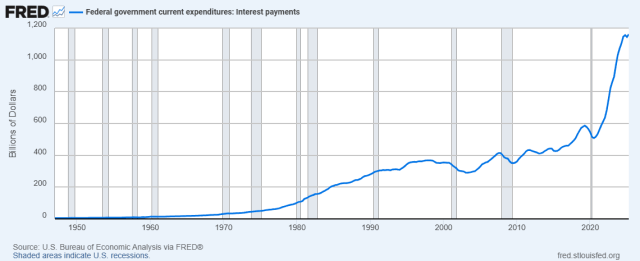
Albert Einstein is often quoted as saying that compound interest is “the most powerful force in the universe.” The quote is probably apocryphal, but it reflects a mathematical truth. Interest on earlier interest grows exponentially, outrunning the linear growth of revenue and eventually consuming everything. That is where the United States now stands. The government […]
-
Everlasting Collapse: 70 Years’ Predictions of China’s Imminent Doom
From 1980-2008, EU GDP grew 2.7%, the US 3%, and China 9% . Since then, the EU has averaged 1.5%, the US 1.8% and China 7%. In other words, China’s economy has grown 300% faster than Western countries’ and, as they slip out of the top bracket of high income countries, China is entering it. […]
-
Why New York City Needs a Public Bank
We will build a city-owned bank — not to serve shareholders, but to serve you. A bank that invests in housing, in transit, in climate resilience. A bank that puts our money to work for our people. — Zohran Mamdani, Victory Speech, Nov. 4, 2025 New York City has elected a mayor who dares to challenge […]
-
Profits, Prophets and Overvalued AI Stock I
In an industry of seedy soothsayers, cocksure charlatans and resourceful rogues, honest and accurate appraisals are exquisitely rare. When it comes to economics, investments and finance, this is particularly so. Certitude, however, tends to be in abundance for those predicting the next financial crash, the sort that will singe earnings and strafe savings. Take, for […]
-
How a Fed Overhaul Could Eliminate the Federal Debt Crisis, Part II: Curbing Fed Independence
There has been considerable discussion in recent years about reforming, modifying, or even abolishing the Federal Reserve. Proposals range from ending its independence, to integrating its functions into the U.S. Treasury Department, to dismantling it and returning monetary policy to direct congressional or Treasury oversight. The Federal Reserve Board Abolition Act (H.R. 1846 and S. 869, 119th […]
 English
 Arabic
 Chinese (Simplified)
 Dutch
 French
 German
 Italian
 Portuguese
 Russian
 Spanish