-
Geoffrey Hinton, AI, and Google’s Ethics Problem
Talk about the dangers of artificial intelligence, actual or imagined, has become feverish, much of it induced by the growing world of generative chat bots. When scrutinising the critics, attention should be paid to their motivations. What do they stand to gain from adopting a particular stance? In the case of Geoffrey Hinton, immodestly seen […]
-
The Causes of Dogmatism
Orientation In part I of this series, following the work of Judy J. Johnson in What’s so Wrong with Being Absolutely Right: The Dangerous Nature of Dogmatic Belief, we identified dogmatism — not as the content of a particular ideology but as a process of thinking, emoting and acting. We distinguished dogmatism from fanaticism and […]
-
Why Would Anyone Ever Assume We’re Not Being Manipulated 24/7?
So many people I know get very defensive when I discuss the plandemic machinations. They either can not accept that manipulation is the standard operating procedure for those in charge or that they would ever be gullible enough to be tricked on a regular basis. That’s when I tell them about the Gruen Transfer. Victor […]
-
The Dogmatic Personality

Orientation Dogmatisms as a process not content What does it mean to think dogmatically about something? On the surface, dogmatism seems associated with religious beliefs. While most world religions can be dogmatic, this implies there is no dogmatism outside of religion. We know that is not true. Many people accuse socialists of being dogmatic. In […]
-
Leaving Patholopolis
With each crossing of the street, with the tempo and multiplicity of economic, occupational and social life, the city sets up a deep contrast with small town and rural life with reference to the sensory foundations of psychic life. — Georg Simmel1 Five thousand years ago, the first cities emerged as, and remain today, marketplaces–concentrated […]
-
Human Life Dissected
No, I am not a surgeon. I am an organizational not a clinical psychologist. What, you might wonder, then, gives me any authority on this subject. Having written probably thousands of words about it over the decades probably gives me sufficient cache. Readers, you be the judge of whether I have overstepped my limits at […]
-
Three Reasons Why Public High Schools Don’t Teach Critical Thinking
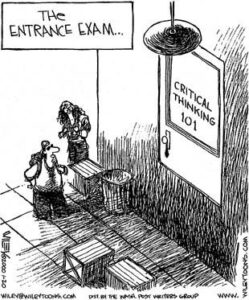
The following warning should be affixed atop every computer in America’s schools: Proceed at your own risk. Don’t accept as true what you’re about to read. Some of it is fact; some of it is opinion masquerading as fact; and the rest is liberal, conservative, or mainstream propaganda. Make sure you know which is which […]
-
ChatGPT: Boon for the Lazy Learner
Inside the beating heart of many students and a large number of learners lies an inner cheat. To get passing grades, every effort will be made to do the least to achieve the most. Efforts to subvert the central class examination are the stuff of legend: discreetly written notes on hands, palms and other body […]
 English
 Arabic
 Chinese (Simplified)
 Dutch
 French
 German
 Italian
 Portuguese
 Russian
 Spanish